PORSCHE 901.343.703.01 Front Sway Bar Control Levers Links 65-67 912 13MM
fits model: 911. make: Porsche.
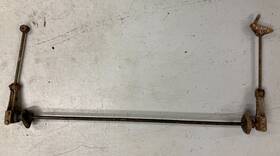
( Manufacturer Part Number: 901.343.703.01 ), ( Type: Sway Bar 13mm ), ( Vintage Part: Yes ), ( Placement On Vehicle: Front )
Review PORSCHE Original 65-67 912 13mm Front Sway Bar And Control Levers Drop Links fits 911
The **Porsche 901.343.703.01 suspension sway bar control levers and links** for the iconic **1965 1967 911 and 912 models** represent a rare and highly sought-after piece of original Porsche engineering, designed to refine the handling dynamics of these legendary roadsters and coup s. These components were part of the factory suspension upgrade package, specifically tailored to enhance stability and cornering precision by adjusting the sway bar s effectiveness an innovation that set the 911 apart from its contemporaries. The **13mm sway bar control levers and links** were meticulously crafted from high-quality steel, featuring a robust, slightly tapered design that ensures durability while maintaining a clean, functional aesthetic. The levers, positioned at the front of the car, connect directly to the sway bar, allowing drivers to fine-tune the anti-roll bar s resistance to body roll, thereby improving weight transfer and grip during aggressive cornering. The accompanying links, forged with precision, articulate smoothly within the suspension geometry, minimizing play and ensuring consistent performance. These parts were not merely aftermarket additions but were originally fitted to select 911 and 912 models as part of Porsche s commitment to optimizing the driving experience, particularly for those who pushed the limits of the car s capabilities. Today, they remain a prized restoration or upgrade component for enthusiasts seeking to preserve or enhance the original character of their 911 or 912, offering a blend of authenticity and performance that is unmatched in the classic Porsche community. Whether installed as part of a full suspension rebuild or as a standalone enhancement, these levers and links embody the engineering brilliance of the era, delivering a tangible connection to the car s heritage while ensuring modern reliability.
### **Pros and Cons of Buying a Porsche 911 (901/912) from 1965 1967 with 13mm Front Sway Bar Control Levers/Links**
#### **Pros**
**1. Classic Design and Prestige**
The Porsche 911 (901/912) from the mid-1960s is one of the most iconic sports cars ever made. Its timeless design, air-cooled engine, and rear-engine layout make it instantly recognizable and highly desirable among enthusiasts. Owning one carries prestige and is a statement of automotive heritage.
**2. Strong Engine and Performance**
The 911 s flat-six air-cooled engine (initially 1.6L in the 912, later upgraded to 2.0L in the 911) is legendary for its smoothness, reliability, and character. The 911 models from this era produce **125 150 horsepower**, depending on the variant, which is more than adequate for its weight ( 1,000 1,100 lbs). The engine s simplicity and durability make it a joy to drive, especially on open roads.
**3. Mechanical Simplicity and Repairability**
Compared to modern cars, the 911 s mechanical systems are straightforward. Many parts are still available from Porsche and aftermarket suppliers, and the lack of complex electronics makes troubleshooting easier. Basic maintenance (oil changes, timing belt replacements) is manageable for those with mechanical aptitude.
**4. Driving Experience**
The 911 s rear-engine layout provides a unique weight distribution, leading to a sporty, balanced handling feel. The manual transmission (if equipped) offers a direct and engaging driving experience. The car s lightweight construction and solid rear suspension make it nimble for its size, especially in the 912 variant (which is lighter than the 911).
**5. Investment Potential**
Well-preserved examples of these early 911s and 912s have appreciated significantly over the years. A properly maintained car from this era can be a sound long-term investment, particularly if it s a rare or well-documented model (e.g., early 911s with the "901" badge, which was later rebranded as "911").
**6. Customization and Modification Potential**
The 911 s platform has been a favorite for modifications since its inception. From engine upgrades (e.g., larger air-cooled engines, turbocharging) to suspension tweaks (like the 13mm front sway bar control levers/links you mentioned), there are endless ways to enhance performance and handling. The aftermarket for parts and accessories is robust.
**7. Community and Ownership Experience**
Owning a classic Porsche connects you to a passionate community of enthusiasts. There are numerous clubs, meetups, and events (e.g., Porsche Club of America, Concours d Elegance) where owners can share knowledge, restore cars, and enjoy the camaraderie of like-minded individuals.
**8. Low Fuel Consumption (By Modern Standards)**
The 911 s air-cooled engine is thirsty by today s standards ( 12 15 MPG), but for its time, it was efficient. The 912, in particular, was designed to be more fuel-efficient than the 911, making it a practical choice for daily driving in the 1960s.
---
#### **Cons**
**1. High Maintenance Costs**
While the engine is simple, the 911 s air-cooled system requires regular attention to prevent overheating and rust. Key components like the **timing belt, water pump, head gaskets, and rear diff seals** are prone to failure and can be expensive to replace. Rust is a major concern, especially in older models, particularly in the **subframe, rear diff, and suspension components**.
**2. Rust and Structural Issues**
Many 1965 1967 911s and 912s suffer from **rust in critical areas**, such as the rear subframe, rear diff housing, and suspension mounts. A thorough inspection (or a rust-free example) is essential. Structural rust can compromise safety and require costly repairs.
**3. Aging Suspension and Steering**
The original suspension components (shock absorbers, springs, bushings) are worn out after 50 years. The **13mm front sway bar control levers/links** you mentioned are an upgrade from the stock setup, which can improve handling but may still require frequent adjustments or replacement. Power steering (on later models) can also fail, adding to maintenance costs.
**4. Electrical System Reliability**
The 911 s electrical system is basic by modern standards and can be finicky. Issues like **failing alternators, voltage regulators, or wiring harness problems** are common. The 912, in particular, had fewer electrical frills, but even the 911 s system requires vigilance.
**5. Fuel and Emissions Challenges**
Finding **lead-free fuel** (required for modern engines) can be difficult, and some older cars may struggle with emissions regulations if modified. While the 911 can be made street-legal with proper modifications, it may not pass emissions tests in some regions without additional work.
**6. Limited Comfort for Daily Use**
The 911 s hard-top or convertible body styles offer minimal insulation from wind noise and road vibrations. Seating is firm, and visibility can be limited due to the low roof and rear-engine layout. While this enhances the driving experience, it can be uncomfortable for long commutes or daily errands.
**7. Parts Availability and Lead Times**
While many parts are still available, some rare or discontinued components (e.g., specific suspension parts, interior trim) may require sourcing from specialty suppliers or international markets. Lead times can be long, which can be frustrating for restorations.
**8. Insurance and Storage Costs**
Insuring a classic Porsche is expensive, especially for high-value models. Storage (garage or climate-controlled) is also a significant ongoing cost to prevent further deterioration. Theft is a risk, as these cars are often targeted by thieves.
**9. Driving Limitations**
The 911 s rear-engine layout means **poor forward visibility** and a **long tail** that can be tricky in tight parking spaces or urban driving. The manual transmission (if equipped) can be stiff, and the clutch may wear out over time. Automatic transmissions (introduced later) are more reliable but still require maintenance.
**10. Potential for Hidden Issues**
Many older 911s have been **poorly maintained** or modified with incompatible parts. Common problems include:- **Engine issues** (head gasket leaks, rod bearing wear, oil leaks)
- **Transmission problems** (syncro failures, clutch wear)
- **Suspension wear** (worn bushings, rusted control arms)
- **Body rust** (especially in the rear subframe and wheel wells)
A **pre-purchase inspection (PPI) by a Porsche specialist** is **mandatory** to avoid costly surprises.
---
### **Conclusion**
Buying a **1965 1967 Porsche 911 or 912 with 13mm front sway bar control levers/links** is a rewarding but challenging endeavor. These cars are **timeless classics** with **exceptional driving dynamics**, **strong engine character**, and **investment potential**, but they come with **significant maintenance demands**, **rust risks**, and **high ownership costs**.
If you are **mechanically inclined**, **financially prepared for repairs**, and **willing to invest time in restoration**, a well-documented example can be an incredible project car or a daily driver with modifications. However, if you seek **low-maintenance, modern convenience**, or **reliability**, this is not the right purchase.
The **13mm front sway bar control levers/links** you mentioned are a **positive upgrade** for handling, but they do not eliminate the need for a **thorough inspection** of the car s structural integrity, engine condition, and suspension components.
---
### **Recommendation**
1. **If You re Buying for Investment or Driving:**- **Prioritize a car with a clean title, full service history, and minimal rust.**
- **Avoid examples with major body rust (especially rear subframe) or engine issues.**
- **Consider a 912 over a 911 if you want a lighter, more fuel-efficient model with fewer electrical quirks.**
- **Budget for at least $50,000 $100,000 **, depending on condition and rarity.
2. **If You re Buying as a Restoration Project:**- **Look for a car with a solid structure, a good engine, and a manageable rust situation.**
- **Factor in the cost of a full restoration (bodywork, engine rebuild, suspension refresh).**
- **Join a Porsche restoration forum (e.g., Porsche 911 Club) for guidance on sourcing parts and avoiding common pitfalls.**
3. **If You re Unsure:**- **Rent or borrow one first** to experience its driving dynamics before committing.
- **Attend auctions or classic car shows** to compare examples and negotiate prices.
- **Consult a Porsche specialist** for a **pre-purchase inspection** this can
Details:
Please See My Other Listings For Rare And Classic Air Cooled Porsche Parts. Original 65-67 Porsche 911 912 13mm Front Sway Bar With Control Levers Drop Links, Part No. 901.343.703.01, Used, In Good Condition. Removed From A 1965 911.
part #: 90134370301 price
- $399.00
specifications swabasus:
- for models: 911
- for makes: Porsche
- mpn: 901.343.703.01
- type: Sway Bar 13mm
- vintage part: Yes
- placement on vehicle: Front
payments swabasus:
- wallet: Apple-pay
- credit card: Diners-club
- other
shipping swabasus:
- transit: 8-12 Days
- cost: $40.31
- carrier: UPS
- class: Standard
- type: Calculated
- service: UPS Ground
seller swabasus:
- city: Orefield, Pennsylvania
- # reviews: 2034
- rating: 100.0%
returns swabasus:
- policy: No Returns
general swabasus:
- condition: Used
- Car Truck Parts Accessories > Steering Suspension > Sway Bars, Links Bushings
offer swabasus:
- started: April 13, 2026
- best offers: True
- quantity: 1
- options: Ship-to-home
- availability: In Stock
- sold: 0
Porsche 901.343.703.01 Is Similar To:
- 2035602 Lemfoerder New Sway Bar End Link Rear Driver Side Porsche (32.5% similar) Some items on are significantly discounted off our regular retail price. Porsche: this sway bar end link - rear driver side is a brand new part manufactured by lemonade. And you return 55. Fitment please see the compatibility's section. Items are not returnable if they in the original sealed ...(November 4th, 2018)
- 26532 Febi New Sway Bar End Link Front Passenger Side Porsche (29.5% similar) Discounted shipping and combined is available on our web site. Porsche: boaster this sway bar end link - front passenger side is a brand new part manufactured by FBI. Fitment information may not be available for all products. Standard shipping is sent via FedEx smart post which a 5-9 day economy ...(June 19th, 2018)
- 377 43001 066 Wd Express Oe Supplier Suspension Stabilizer Bar Bushing Fits Porsche (7.9% similar) Be extra careful that you are purchasing the right item so will not have any fitment issues...(July 18th, 2018)
- 477.511.411.a Porsche Rear Sway Bar Linkage Mm (34% similar) Porsche 944 rear oem sway bar and linkage. Diameter of the sway bar is 14MM. Removed from a base but will fit other years...(May 20th, 2018)
- 477411313m Genuine Porsche New Sway Bar Bushing Rear (28.6% similar) And you return cores: any cores must be in rebuild able condition with sufficient parts to rebuild said core rust, corrosion, OK. Standard shipping is sent via FedEx smart post which a 5-9 day economy service. Fitment please see the compatibility's section. The price is as it states on. 95 and is ...(June 21st, 2018)
- 65-215885-1 Weltmeister Porsche Front Sway Bar Kit (33.1% similar) And where others require removal of parts to make changes, our bars adjust by loosening adjusting one bolt. Voltmeter kits are custom designed for ease of installation with a complete instruction guide included in every kit. Further chassis tuning is adjustable drop links. Voltmeter provides ...(March 12th, 2018)
- 65-224071-1 Porsche Suspension Sway Bar Front Pro Series Eckler (40.5% similar) Complete kits include large, precision Teflon-lined rod ends for long life and smooth operation. Manufactured from 4130 chromosomal alloy steel, they are heated to maximize strength and reliability. Voltmeter bars weigh half as much a solid bar, yet offer the same stiffness. Thermoplastic bushings ...(March 30th, 2018)
- 7214.310 Eibach Front Sway Bar Kit For Porsche Turbo (40.8% similar) Bach anti-roll front sway bar kit 24MM for porsche 911 turbo size. Front sway bar is solid and non-adjustable. These kits reduce body roll through increased design stiffness over stock bars. Please see the for information regarding shipping costs and available methods. The results are increased ...(April 25th, 2018)
- 7217.310 Eibach Front Sway Bar Kit For Porsche Turbo Coupe (35.3% similar) Bach anti-roll front sway bar kit 25MM for porsche 911 turbo coupe size. Front sway bar is tubular and 3 way-adjustable. Please see the for information regarding shipping costs and available methods. These kits reduce body roll through increased design stiffness over stock bars. Hibachis anti-roll ...(April 25th, 2018)
- 782789357604 Porsche Lots Sway Bar Bushing (33.6% similar) LOC-1302 sway bar bushing 18MM , rear axle porsche 911 Bk turbo 964 944 968 reference no: 477411313B 313N. 313B 477411313N 477...(March 6th, 2018)
- 7l0411025 Porsche 06 Cayenne Front (26.4% similar) ...(February 19th, 2018)